
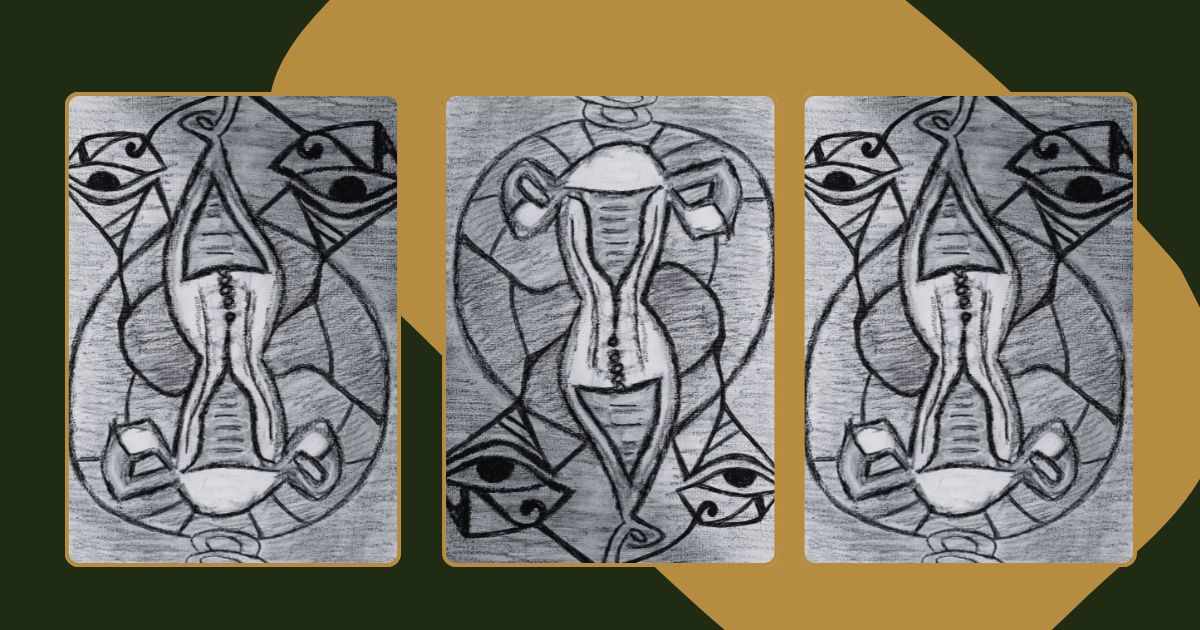
Last Wednesday 10th December, I said a very fond farewell to my ovaries; the female organs which produced the egg that created my son and kept my hormones in check (most of the time) for nearly 50 years. When you stop to think about it, the human body is spectacular. If we take care of it, and often when we don’t, it works in perfect synergy sending blood, water, oxygen, lymphatic fluid, electrolytes, vitamins, minerals (the list goes on) to exactly the right place at exactly the right time with barely any conscious thought or action.
Until it doesn’t. Sadly, dis-ease can send the body skittering and serious decisions have to be made to bring it back into alignment to give ourselves the best chance of longevity.
My story starts in the summer of 2020, at the height of Covid. I’d just turned 47 and I’d found myself at the perimenopause stage of life, a completely natural time of transition when a woman’s body becomes less fertile. I didn’t find it easy, the drop in hormones was a shock to my system and I began to struggle with sleep disturbance, brain fog, anxiety and loss of confidence.
During that time, I did a lot of menopause research and empowered by the information I was uncovering, I sought out a local reputable private menopause clinic, where I was prescribed body identical hormone replacement therapy – oestrogen, progesterone and testosterone. I understood there was a link to a small risk of breast cancer but the publicity surrounding the positives for women taking this type of HRT was ramping up, and I decided the benefits were greater. It worked; I got my mojo back. I spoke to the menopause doctor every few months to review the prescription, had annual pelvic scans and cracked on with life.
HRT today, gone tomorrow
Fast forward just over two years, to Christmas 2022. For a few weeks, I’d noticed my right breast was flat at the bottom where the curve should be. I’d poked it in the shower but I couldn’t feel anything so I carried on with the Christmas madness and put it to the back of my mind. On New Year’s Eve, I decided to have a closer inspection, and to my horror I discovered an area of dimpling and a lump.
I booked an emergency appointment to see a GP at my regular surgery on 4th January 2023, and following an examination I was referred to the breast clinic on the 14-day NHS pathway. Later that day, I received a call from the doctor to advise me to stop taking HRT. Immediately. I was terrified. Would my symptoms come back? Did I have cancer? What was happening to my body? Was it the HRT?
A couple of weeks later, a biopsy confirmed that it was very likely that I did have breast cancer and I was told to mentally prepare myself.
The confirmed diagnosis of invasive lobular breast cancer came a few weeks later. Cancer is all consuming and any fears that I had regarding menopause symptoms quickly dissipated – or merged with the fear of my possible impending demise!
Following a lumpectomy of the right breast, which saw the removal of 28mm of lobular cancer and an axillary clearance of 23 lymph nodes from my right armpit, three of which were positive, I was given ‘belt and braces’ treatment. This consisted of eight rounds of bi-weekly chemo over four months, and then 15 sessions of five-day a week radiotherapy. When active treatment finished in September 2023, I began endocrine therapy. At first daily Tamoxifen, which was later switched to Letrozole at my request (better for lobular) and an injection of Zoladex in the stomach every 30 days to switch off my ovaries. Like removing the electricity from a light bulb; the ovaries remain intact but their activity is halted, putting a woman into medical menopause in a matter of weeks.
In or out?
In the summer of 2024, I was given the option to have my ovaries surgically removed, and in January 2025, I joined the (very long) waiting list. Deciding to cut out your ovaries and fallopian tubes – a bilateral salpingo-oophorectomy – is not an easy choice to make. It is irreversible, but for me it was the right decision. I’d already spent two years in medical menopause and was now managing the symptoms well – mostly nighttime hot flushes. Plus, it meant the end of the fairly brutal monthly Zoladex implant injection (the syringe is the size of a small screwdriver), but most importantly, it will hopefully prevent my cancer from recurring or spreading to other parts of my body.
I consider myself extremely fortunate to be making this decision at this time of life, my childbearing days are very much behind me but many younger women are faced with this choice, and my heart goes out to them all.
Did HRT cause my cancer? I truly believe it was rocket fuel for lobular to run rampant, but that doesn’t mean that the cancer was not already there. Would I have taken HRT if I’d known about lobular? Maybe, I was fit and healthy, I didn’t ever imagine being diagnosed with breast cancer – or any cancer – at 49 years old. But had I known. I would have reached a much more rounded decision.
It’s absolutely essential that women have access to a range of treatments to manage debilitating menopause symptoms. Menopause is natural but it’s not easy. Too often women are disregarded, expected to go away and get on with it. Access to medication should be mirrored with up-to-date detailed information about breast cancer types and statistics so we can weigh up the risks and make truly informed choices. Many doctors across the country have never heard of lobular breast cancer. This is why education across the medical community – and for patients – is vital.
Lobular breast cancer makes up 10-15% of breast cancer diagnoses that’s 22 women diagnosed in the UK every single day – 1000 globally. According to a recent American Cancer Society Lobular Breast Cancer Statistics, 2025 report, which was published on 7th October 2025, lobular breast cancer rates have more than doubled over the past several decades, climbing from six cases per 100,000 women in 1975 to around 14 cases by 2021.
The report notes this upward trajectory follows a similar pattern seen across breast cancers generally, primarily due to increased mammography screening. However, lobular is very difficult to see on mammogram due to its growth pattern and often doesn’t form a lump. The report says that between 1998 and 2004, lobular diagnoses temporarily dropped following the Women’s Health Initiative’s findings linking menopause hormonal therapy (HRT) to elevated breast cancer risk. This led to a decrease in HRT use, and lobular cases fell more sharply during this period compared to other breast cancer types – a pattern the report explains aligns with research indicating lobular cancer has a stronger connection to hormonal factors than the more common ductal breast cancer.
My journey with lobular opened my eyes to systemic failures in our healthcare system, failures I explore in depth in my upcoming book, The Healthcare Rebellion (2027). The book opens with my shock diagnosis and the devastating discovery that this disease, first identified over 80 years ago, has no specific treatment. In the first two chapters, I detail the immediate healthcare failures surrounding the lack of research and funding for lobular, my introduction to the Lobular Moon Shot Project campaign and the unique challenges this disease presents.
Source: American Cancer Society. Lobular Breast Cancer Statistics, 2025. CA: A Cancer Journal for Clinicians. Available at: https://acsjournals.onlinelibrary.wiley.com/doi/full/10.1002/cncr.70061
Read more about The Healthcare Rebellion (2027).
Artwork by Kate Ford Michaels.
Leave a Reply