
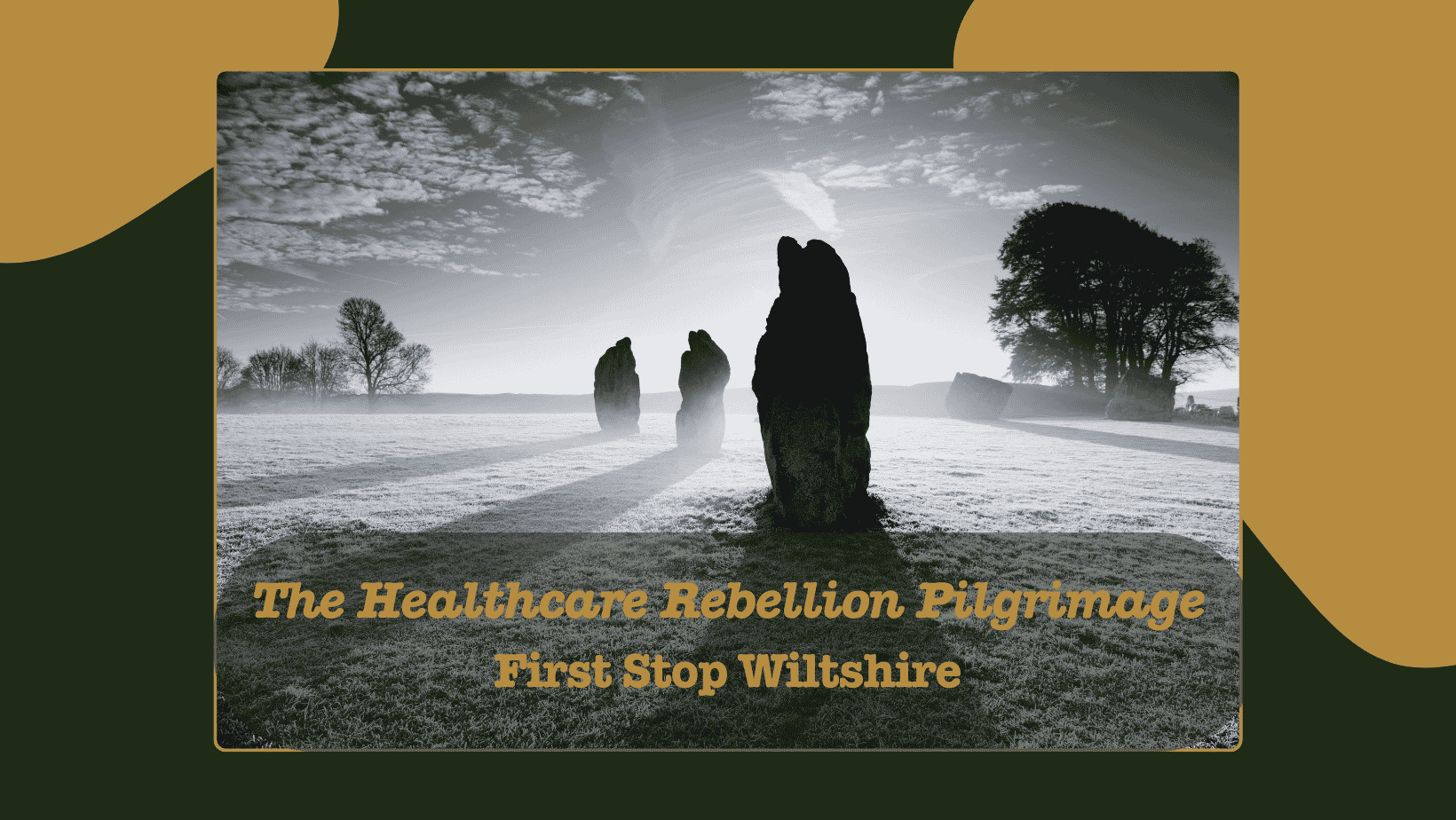
When I first started pulling the strands of ideas together for The Healthcare Rebellion last Autumn, I assumed the research would mostly be carried out online from home. I hadn’t realised that just a few months later, my plans for the future would change dramatically. I talked about this in the June blog – The Road is the Research, where I unveiled my intension for a UK tour in my tiny home on wheels, Birdie.
If you’ve watched my YouTube channel you’ll know Birdie’s conversion is now well underway. She’ll soon be ready for our adventures to begin, which is incredibly exciting! Whilst she’s been away, I’ve been thinking about how best to align my travels with the stories I plan to tell, and I’ve decided to rejig the book’s outline. Now spread across four parts, each section will begin with a chapter about my journey, weaving together past and present – a Healthcare Rebellion pilgrimage.
Not only will I visit many of the places that I feature in the book, I’ll fully immerse myself in the ancient landscapes and stories of the women I’m documenting, and of course interview people in person along the way.
Which leads me to the first leg of the journey, from March to June 2027. My quest will start in Avebury, Wiltshire, the place that inspired Swedish artist Monica Sjöö, who died of metastatic breast cancer on 8th August 2005 – 21 years ago today – to paint the stunning The Goddess at Avebury and Silbury. I was lucky enough to see this huge iconic painting in person at her retrospective exhibition, Monica Sjöö: The Great Cosmic Mother, in January 2024 at Modern Art Oxford. A pivotal figure in the Women’s Liberation Movement, Sjöö’s campaigning, art and published letters provide an important link to women’s activism in the UK from the 1970s and beyond.
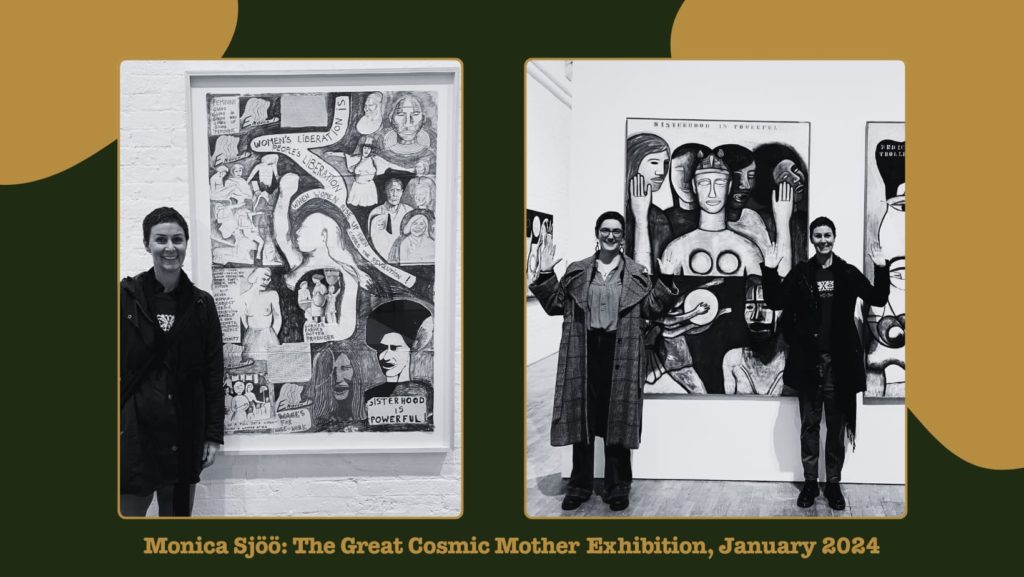
At the Monica Sjöö: The Great Cosmic Mother exhibition in January 2024 with my friend , Six Inches of Soil Producer Claire Mackenzie.
Untangling Inequality
The threads of inequality run deep in the rich tapestry of British history. I’ll visit the Salisbury area where a number of women were tried for witchcraft in the 16th and 17th centuries at the Salisbury Assizes. In spring 1564, Agnes Mylles was the first known woman to be executed in England for the crime, which was restored into statutory law in 1562 by Queen Elizabeth I. The first Witchcraft Act passed by Henry VIII in 1542, was repealed after his death in 1547. Like many who came after her, Agnes, an impoverished widow, was accused of using ‘cunning’, in this case to murder the child of a wealthy local family.
From Wiltshire I’ll head to Somerset. On the itinerary is Bathwick, once the home of clergyman Reverend Montague Summers, who was the curate at local church St. John the Baptist. In 1928, Summers, a modern day ‘witch hunter’, translated The Malleus Maleficarum (1487), a text by German inquisitor Heinrich Kramer that fuelled horrifying tyranny. It provided legal and religious justification to discriminate, mostly against women and girls, claiming females were more susceptible to witchcraft.
State Stealing Babies
Devon and Cornwall are next on the agenda. One of the sites I’m interested in visiting is Rosemundy house in St Agnes, Cornwall. From 1919 to 1964, it was a Mother and Baby Home and part of the forced adoption scandal. It’s now a hotel, and on 10th May 2025, a plaque to commemorate the women who lived there was unveiled, serving as a monument to mark this shocking period in recent history. The UK saw an estimated 185,000 babies taken from unmarried mothers between 1949 and 1976, their punishment for straying from the ‘nuclear family’ social expectation. The psychological trauma of this remains and the full extent of the damage caused has only recently been acknowledged.
In March 2023, then Scottish First Minister Nicola Sturgeon said, “The horror of what happened to these women is almost impossible to comprehend”. An ITV investigation uncovered evidence that some young women, who were sent to mother and baby homes run by church and state, were given the drug Diethylstilbestrol, commonly known as DES, to dry up breastmilk. DES was known to increase the risk of women developing breast cancer. The Healthcare Rebellion will examine this travesty and explore the effect it’s had on women’s health.
Last month, on 2nd July 2026, then Prime Minister Keir Starmer finally issued a formal apology in Parliament saying, “It is a stain on our history.” He added, “The State did not prevent harm from continuing. The State bears responsibility for the systems it funded and legitimised, which enabled these practices to occur. The State did not do enough to protect mothers, children and families from harm. And for this systemic failure, I am truly sorry.”
From Cornwall, I plan to head to Exmoor, Bristol and then on to Oxford where the first National Women’s Liberation Conference in Britain took place, from 27th February to 1st March 1970. The first leg of the tour will end in Berkshire in early June 2027 at Greenham Common, which in many ways was the start of this book.
In early 2024, a few months after my active treatment for lobular breast cancer finished, I started planning a Zine about the epic Greenham Common Peace Camp, a women’s protest that lasted 19 years. What was going to be a Zine has become a book with a much wider scope, telling stories of women’s oppression across the UK and how that links to the healthcare system today.
I’d love for you to join me on this journey. Please get in touch with your stories, and follow me on socials for regular updates:
Instagram:
@katefordmichaels
@abundanttimes_
YouTube:
Abundant Times
Leave a Reply